AI should do more than automate existing work. Organizations that rethink how work gets done will create value that automation alone never can.
By Lisa Taylor
Years ago, I led a business unit at one of the world’s largest technology companies through multiple periods of transformation. One of the biggest began when a new CEO arrived.
Over decades, the company’s culture had come to value collaboration, care, and thoughtful decision-making. But as new technologies reshaped our industry, globalization disrupted supply chains, and demographic change altered our workforce, our new CEO pushed us to think differently about change and risk. We were, as she put it, “flying the plane while building it.”
Sound familiar?
The most valuable lesson that CEO taught me was a concept that felt heretical to the company’s engineers: good enough.
Nobody wants a good enough tech product or a good enough security system. But that wasn’t the point. She was teaching us to distinguish between work that demanded exceptional effort and work that just needed to move forward. Perfection has a cost, and knowing where it matters is a skill.
I’ve been thinking about that lesson a lot lately.
AI has made good enough remarkably easy to achieve. Draft the email. Summarize the report. Organize the meeting notes. Complete the first version in seconds instead of hours.
For many tasks, that’s a real productivity advantage. The trouble starts when good enoughshifts from being a standard for repeatable tasks to becoming the standard for how a whole organization adopts AI.
AI slop is everywhere—content that follows familiar patterns, reaches predictable conclusions, and sounds as though it could have been written by anyone. It is optimized to the average, and that’s led some people to question whether AI is worth adopting at all.
That’s both right and wrong at the same time.
AI is not something we can opt out of; it is here and will only become more integrated into our lives as time goes on. But we do have a choice in how well we adapt to it—and how skilled we are at judging when good enough is perfectly acceptable, and when it won’t cut it.
Without that judgment, AI slop will soon turn into work slop, producing average solutions for average customers.
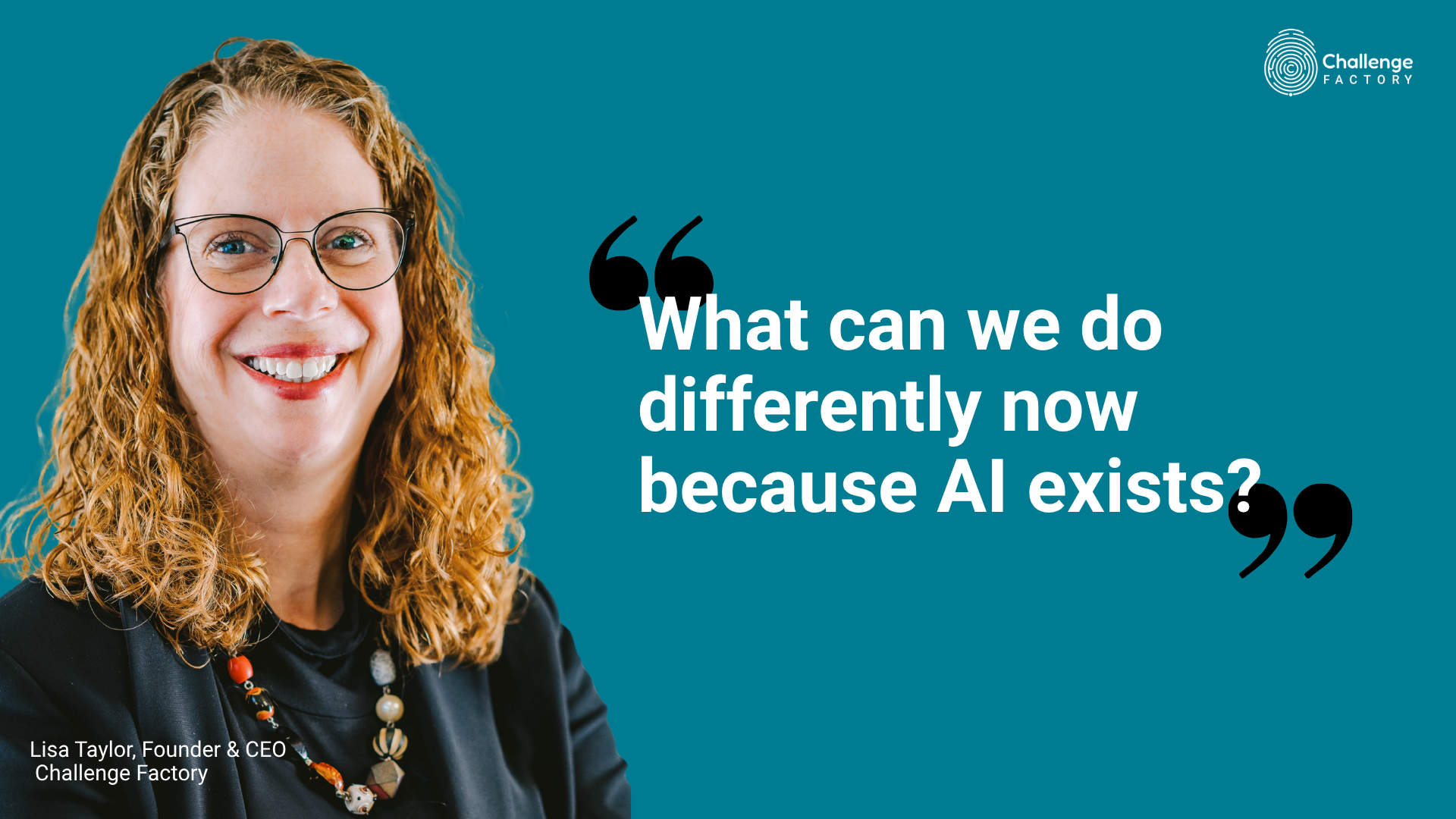
AI can help a researcher synthesize hundreds of studies instead of a dozen. It can help a strategist test multiple scenarios before making a recommendation. It can reveal patterns across years of interviews, reports, and workforce data that would otherwise remain invisible.
When we apply it this way, to change what we’re doing because we now can do more, better, the output and impact becomes transformational.
This summer, our team at Challenge Factory is spending time shifting from being strong individual AI adopters to an organization that adapts and transforms with AI. We’ll be working with our clients as they do the same.
This starts with asking different questions about our own work. Where are we simply accelerating existing processes? Where can AI help us rethink the work altogether? What becomes possible now that wasn’t possible before?
Those questions are far more important than whether an email took five minutes or fifty to write.
The organizations that gain the most from AI won’t be the ones that automate the greatest number of tasks or use AI within siloed functions. They’ll be the ones using it to change how work is done in a way that expands what their people and clients are capable of seeing, creating, and solving together.
That’s an ambition worth aiming for.
Good enough has its place. Just not as the vision for the future of work.
Lisa Taylor is a global authority on the future of work and the systems that shape it. As Founder and CEO of Challenge Factory, she advises governments, multinational organizations, and C-suite executives navigating workforces redefined by AI, longer working lives, and accelerating change. She is the author of multiple books including The Talent Revolution: Longevity and the Future of Work (University of Toronto Press) and a sought-after media commentator who has been featured in The Globe and Mail, Forbes, CBC, Toronto Star, OECD Future of Work reports, and more.