
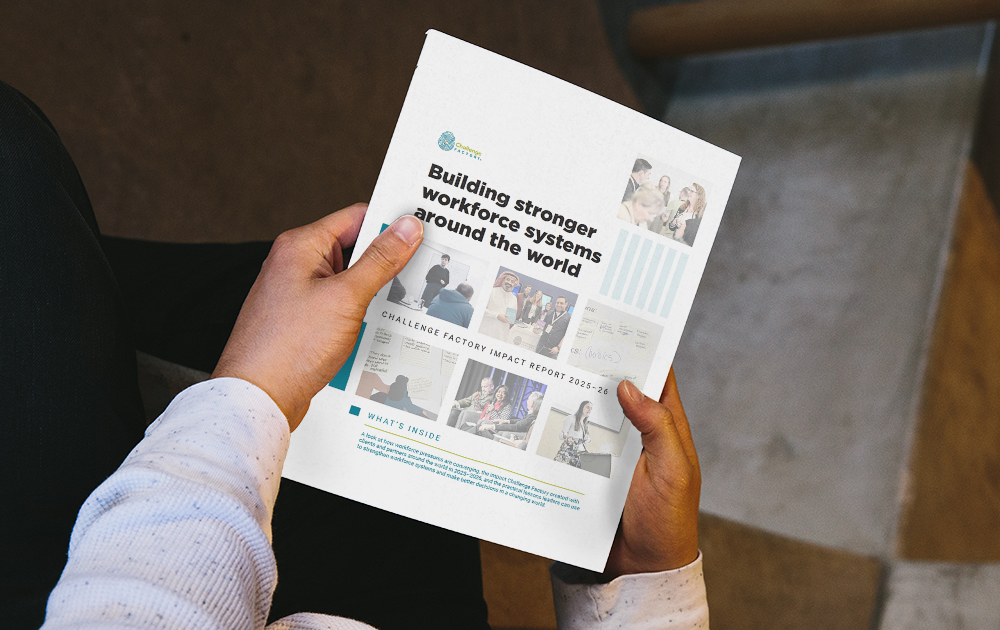
From Canada to Saudi Arabia and beyond, Challenge Factory’s 2025–26 Impact Report showcases a year of ambitious work and the lessons emerging for workforce leaders around the world.
Organizations are investing in AI, skills development, recruitment, and leadership programs. Yet workforce shortages coexist with people looking for work. Employers struggle to find needed skills while overlooking capabilities within their existing workforces. AI promises productivity gains, but organizations are still figuring out how to redesign work to realize those benefits. And as people live and work longer, many workforce systems remain designed around outdated assumptions about careers and retirement.
Why do so many workforce investments fail to produce the expected results?
Challenge Factory’s 2025–26 Impact Report, Building Stronger Workforce Systems Around the World, examines this challenge through four interconnected trends. Drawing on our research, client engagements, and partnerships, the report highlights how organizations can address career and workforce needs at the same time, how they are responding to these pressures, and the lessons emerging from their efforts.
Challenge Factory’s 2025-26 Impact Report
4 trends are changing workforce strategy
AI and work redesign, talent mobility, longer working lives, and the ability to sustain change are often managed as separate organizational challenges. In practice, they continually affect one another and are experienced by individuals making career choices.
AI adoption changes jobs, skills requirements, and career pathways. Longer working lives affect succession planning and how organizations develop and retain experience across all career stages. And the success of any workforce initiative depends partly on how well it connects with existing systems and whether organizations can sustain improvements over time.
When leaders address these pressures independently, they risk investing in solutions that resolve one issue while leaving other problems untouched or creating new ones.
The four trends point to the importance of workforce infrastructure, the systems, pathways, and decision rules that connect people and organizational strategy. Stronger workforce infrastructure enables organizations to coordinate their responses to change and make workforce investments work together.

Shining a light on Challenge Factory’s impact in 2025–26
Throughout the year, Challenge Factory worked with clients and partners to better understand workforce challenges and develop evidence-informed approaches to addressing them. Four examples illustrate the range of this work.
- In Saskatchewan, we helped leaders across education, industry, government, and community organizations identify barriers to youth employment, including gaps in coordination, funding, and employer capacity.
- Our work with Saudi Arabia’s Human Resources Development Fund contributed research, international benchmarking, and practical guidance for strengthening national career guidance infrastructure.
- Our own use of AI helped us create the Career Infrastructure Investment Calculator, which allows organizations to compare workforce investments and test how different assumptions affect projected costs, benefits, and returns.
- We also began developing Legacy Careers®: Design Your Next Chapter, a program designed to help experienced workers explore new career possibilities, test assumptions, and plan their next stage of work and life.
In 2025–26, Challenge Factory undertook 12 major initiatives, engaged directly with 128 organizations, and reached 19 of 20 NAICS sectors. Although the contexts and challenges differed, our work consistently reinforced the value of understanding how workforce systems function before deciding where and how to invest.
Make your next workforce decision with confidence
Leaders are making workforce decisions today that will affect their organizations for years to come. Some changes demand immediate attention. Others may attract considerable investment without addressing the problems that most threaten future performance. And decisions that solve an immediate problem can create new challenges elsewhere in the workforce.
The ability to distinguish among these possibilities is becoming an essential leadership capability. It requires understanding how workforce systems function, anticipating the consequences of different choices, and ensuring that today’s investments don’t limit tomorrow’s options.
Challenge Factory’s work helps leaders understand their workforce systems, test assumptions about the problems they’re facing, and evaluate the implications of different choices before committing resources. As Founder and CEO Lisa Taylor writes in the report: “Workforce strategy can no longer be siloed from business strategy. Capital may fuel projects, but people build organizations and economies.”